Good Shepherd’s Evangeliary
The following was written by Ad Crucem regarding the new Evangeliary we received in memory of Kevin Franks.
Delivering the First Evangeliary for Palm Sunday
A 44-hour project wraps up to provide Good Shepherd Lutheran Church in Tomah, WI with Ad Crucem's very first completed evangeliary.
MAR 28, 2026
A gospel book contains the full text of the four Gospels. An evangeliary, sometimes called an evangelistary, contains the Gospel readings appointed for the church year, arranged by the day they are read. In the Western liturgical tradition, the evangeliary was carried in procession, and treated with a reverence that reflected its contents: the very words and deeds of Christ, ordered according to the annual rhythm of the church’s life. In the medieval period, these books were often lavishly bound in carved ivory, precious metals, and enamel. They were among the most important objects a church possessed.
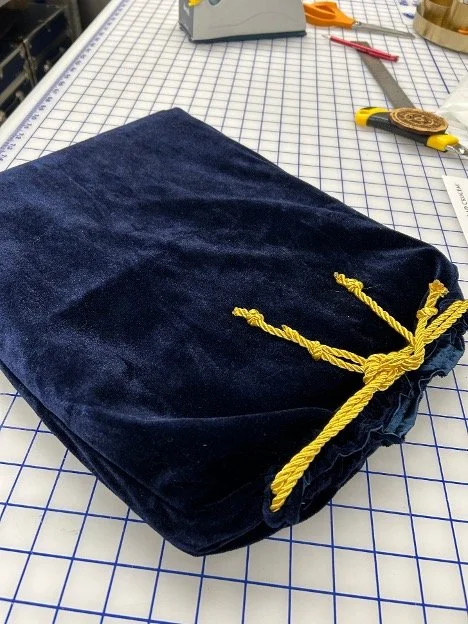
Ad Crucem’s is not made of ivory or gold, but of solid American black walnut protected in a satin-lined royal blue velvet bag made by our seamstress, Tori.
The very first completed Evangeliary, after many prototypes, is now in the hands of Good Shepherd Lutheran Church in Tomah, WI.
Two Leaves, Hinged
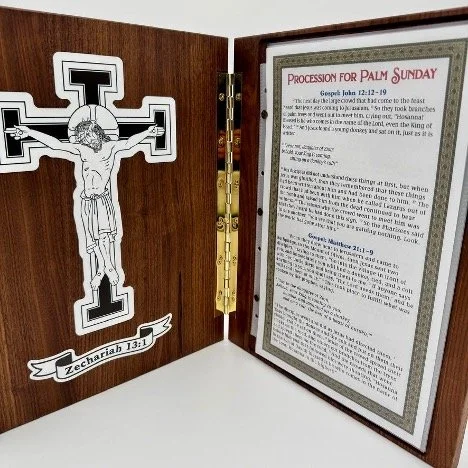
The Ad Crucem Evangeliary is two leaves of 12” x 15” solid American black walnut, joined by a hinge that opens it like a book. But it is a working evangeliary, not merely a decorative cover or ornamental piece. The interior uses a post-and-screw binding system that holds legal-size (8.5” x 14”) folders, allowing the readings appointed for the day to be swapped in and out throughout the church year. The legal-size format means the text is set large and easy to read, from the lectern or in the aisle of the nave, at arm’s length, without strain.
Because this is an evangeliary and not a gospel book, the readings change. The folders can be prepared for each Sunday, each feast, each season. The very first gospel book completed contains the readings for Palmarum (Palm Sunday) and the Palm Procession, a fitting festival for its inauguration.
The form itself is deliberately simple, but there are dozens of hours of machine-milled and hand-finished detail.
The Process
Each evangeliary begins as a drawing and becomes a digital design. That design is transformed into a 3-D model, which is then converted into toolpaths for CNC milling. For this evangeliary, the customer chose “rounded” ornamentation for the front.
The mill does the rough work: cutting the relief, establishing the forms, carving the lettering, but that is only the beginning. What comes off the machine is precise but a little lifeless, even after 32 hours of machining from rough cuts to ultra-fine final milling.
The life comes from what happens next. Every carved surface is carefully hand-sanded to remove burrs and achieve a smooth-to-the-touch finish. Paint is applied to v-carve milling, worked into the recesses of the relief, and built up in thin layers. The figures take on depth and character that no machine can produce on its own. The walnut is oiled and brought to a soft luster that shows enough grain without overwhelming the carving. The result is a unique partnership of precision machining and patient handwork.
It would be appropriate to label it as American religious folk art. It is not trying to replicate a medieval reliquary, nor is it trying to be something made in a German woodshop five centuries ago. It is made in Littleton, CO, on demand with the tools and local materials we have, in a unique tradition we are trying to fashion rather than merely imitate.
The Front Cover: The Lamb and the Four Evangelists
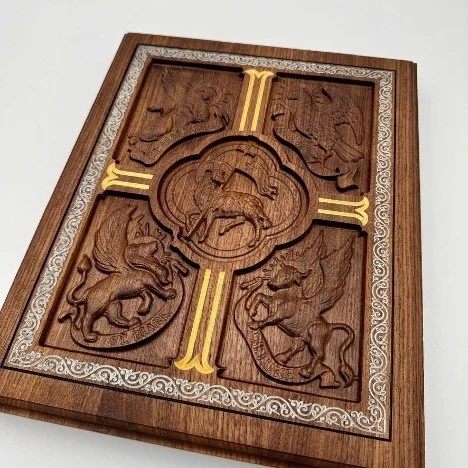
The front cover bears the Agnus Dei Victorious at its center, the Lamb of God, standing and triumphant, carrying the banner of the resurrection. This is not the slain lamb of sacrifice alone but the lamb who has conquered death, the image drawn from Revelation: “Worthy is the Lamb who was slain.” At the end of this Holy Week, we will indeed celebrate the worthy Lamb who atoned for the sins of the whole world.
Surrounding the Agnus Dei are the four evangelists, represented by their traditional symbols drawn from Ezekiel’s vision and the Revelation of St. John.
· Matthew: Represented by the Man (or angel), signifying Jesus as the teacher and human son of David.
· Mark: Represented by the Lion, symbolizing the voice crying in the wilderness and the resurrection.
· Luke: Represented by the Ox (or calf), indicating Jesus as the sacrificial bearer of burdens.
· John: Represented by the Eagle, denoting the high-flying theological discourse on the Word of God.
These four figures have surrounded the Gospel text in Christian art for well over a thousand years. Placing them here, around the Lamb, is not an innovation, but a continuation of the traditions of the historic and ancient Christian church. The arrangement of the evangelists is also consistent with tradition since St. Jerome.
Inside: The Crucifix and the Inscription
Opening the evangeliary reveals two interior panels. The inside of the front cover bears a crucifix (designed by Lutheran artist Ed Riojas) printed on white acrylic and inset into the wood, with the text of Zechariah 13:1 — “On that day a fountain shall be opened for the house of David and for the inhabitants of Jerusalem, to cleanse them from sin and uncleanness.” It is a passage that points forward from the Old Testament prophets to the cross, connecting the promise to its fulfillment.
As the Gospel Reading for the day is delivered to the parishioners, the pastor is aware at all times whose atonement made the good news possible and effective.
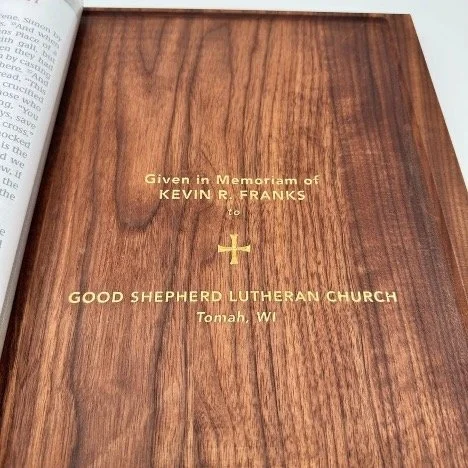
The inside of the back cover is reserved for a custom inscription. Each evangeliary can be lettered to memorialize a gift; the name of a donor, a parish, a loved one, or an occasion. This is a subtle recognition of a specific act of generosity or remembrance.
The Back Cover: Tau Rho Nika
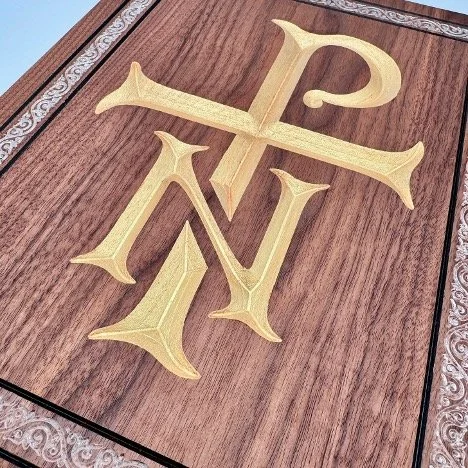
The back cover carries one of the oldest Christian symbols in existence, older, in fact, than the more familiar Chi-Rho. The Tau-Rho, or staurogram, superimposes the Greek letters tau (Τ) and rho (Ρ) to form a shorthand for the Greek word stauros — cross. Visually, the loop of the rho sitting atop the vertical stroke of the tau has long been read as a pictograph: the head of Christ on the cross. It is a symbol that is both an abbreviation and an image.
Above the staurogram sits the letter N, shorthand for the Greek word Nika, “conquers” or “victory.” Together, the composition translates simply: Christ’s cross conquered sin.
The staurogram is carved with a 120-degree V-bit to accentuate the depth and beautiful shape, and painted in iridescent gold, which contrasts beautifully against the dark walnut. The border is painted in iridescent silver, offsetting the gold and giving the panel a balanced frame.
The above was accessed from Ad Crucem here.